


Ask anyone in Vancouver about Grouse Mountain and you'll hear about the Grind, the gondola, the grizzly bears (RIP, Grinder!), skiing in the winter, and the overpriced food (okay, maybe that’s just me). Almost nobody mentions that on the same mountain, an hour's walk from the Skyline Drive trailhead, there is an abandoned, formerly bustling ski village. There are dozens of old cabins, a crashed fighter jet, and a trail built along the line of a chairlift that made history.
This summer, my family and I hiked it. We took the Skyline Trail up to the Simic Trail, onto the ski run many of us know as "the Cut." We saw nobody else all day. What we found was easily the most interesting hike I've done on the North Shore.
First, a note on the name of the Simic Trail: It is named for its builder, North Shore hiking enthusiast John Simic. Like the best local trails, it exists because one person loved these mountains enough to make a way through them. Hikers who use it today are walking a piece of North Shore hiking history.

A map of the route of the Skyline Trail and the Simic Trail, connecting to the BCMC.
The route
The hike starts gently. You warm up on paved Skyline Drive, then take a short stretch of the Baden-Powell Trail before the Skyline Trail begins. From there it's steep from start to finish, which makes it a good choice for exercise and endurance training. There are no technical or treacherous sections, so steepness and rocky footing are the only real challenges.
Don't expect the comforts of the more popular trails, though. There are no steps, ropes, or railings. The path is mostly unmaintained, though consistent markers and a well-worn track make it easy to follow. The trail is more about function than beauty—the regrown forest offers decent shade, but we were there more for the history than the views.
Items in the woods
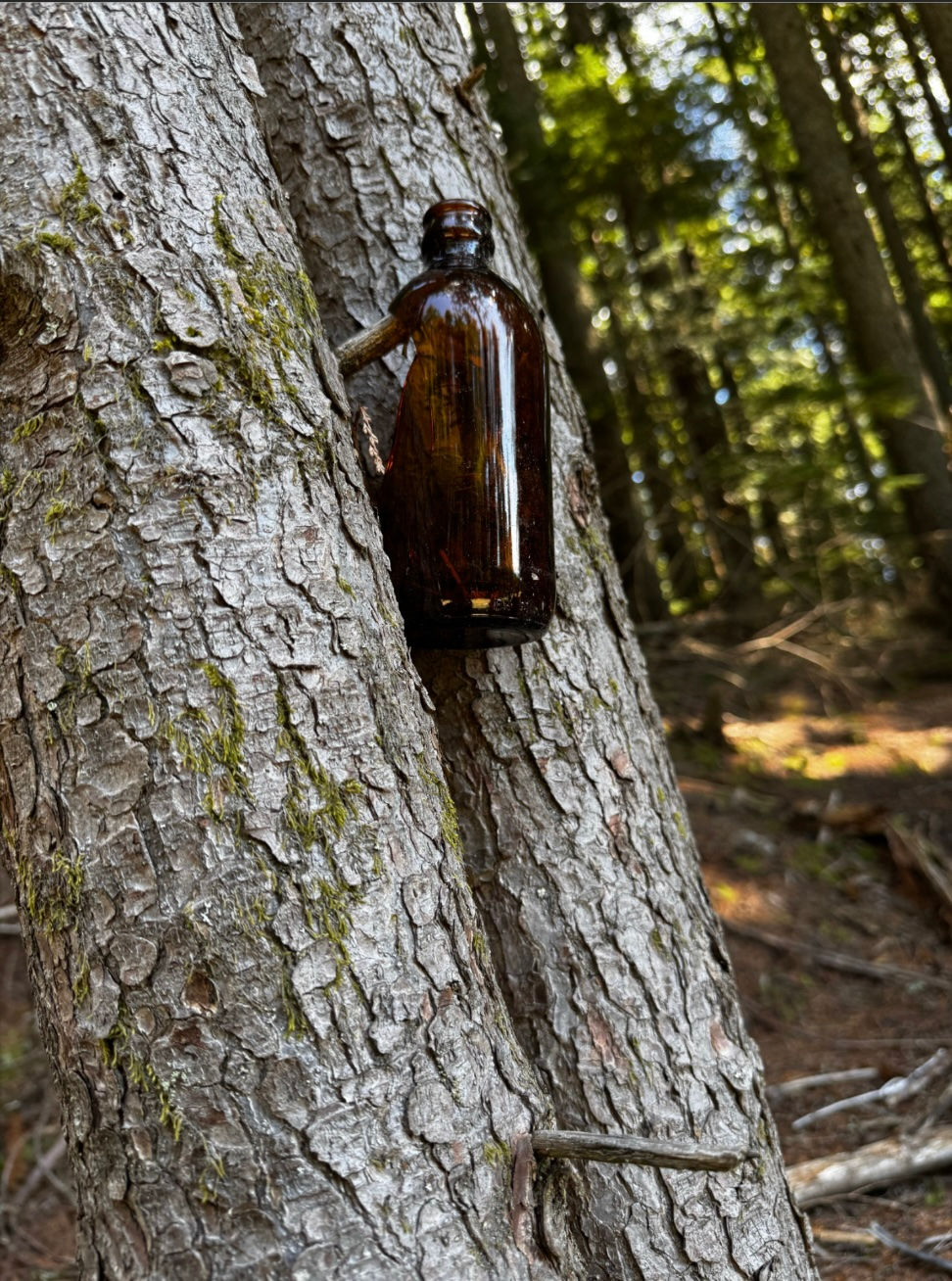
The first sign that this was more than an ordinary hike was the metal. Rusted scraps, wheels, and ceramic-like fragments appeared among the moss, loose rock, and cedar needles. Then came stranger finds: the frame of a rusty bunk bed standing in a patch of grass; a glass medicine bottle with a label dating back to 1918 lodged between two tree trunks, as if someone had wedged it there and walked away; and a full-on toilet and a sink sat in the middle of the woods, a long way from any plumbing.

Later, heading up the forest next to the Cut, I found an old silver-plated fork, engraved with the words “VERNON SILVER PLATE”. After some post-hike digging online, I traced its origin to 1928, and its manufacturer to the Oneida Company, which originated from a 19th-century utopian religious commune.


The cabin area
Moss and fallen trees have swallowed much of what's left of the cabins and building frames in the lower part of the mountain. Collapsed boards, torn sheeting, and bits of furniture lie in heaps where cabins once stood. Every pile is a small time capsule, and there are a lot of them.

But some cabins are still standing, despite their condition. One is a log cabin with a rusting corrugated metal roof and a small dormer window on top. Its front porch has lost its walls, and only the bare frame remains. The old window still has its panes. Another has an arched, barn-like roof and weathered wooden shingles. Two stovepipes poked out of the top, and its door and windows were boarded up. It sits among the trees on the slope as if the owners left for the winter and never came back.


Hiking websites mention a cabin ruin nicknamed 'The Doghouse' near this area, but I can't say for certain which of the structures I saw corresponds to it.

Early history
The story starts long before the ski lifts. In the 1910s and 1920s, Grouse Mountain was a weekend escape for Vancouver-area families. Scandinavian settlers brought a cabin-and-ski culture with them from the old country and built simple wooden getaways on the slopes, a short climb from the city but a world away from it. Before any lift existed, rich people took the ferry across from Vancouver to what we today call the North Shore and hiked up, bush-whacking with machetes, through the dense rainforest. The climb to the top of the mountain is said to have taken hours. Building materials came up the same way, carried on people's backs. Once there, they stayed in home-built log cabins. The first lodge, the original Grouse Mountain Chalet, grew out of this scene, and cabins sprang up around it. These hauling routes became the foundation for what we now call the Grouse Grind.

But then the Great Depression hit. As money vanished, some cabin owners could no longer afford their mountain retreats and left them behind. Others moved in. Squatters lived in the abandoned cabins, and living up the mountain meant living tax-free. The bunk beds, sinks, and kitchenware I found may well date from those years, when the mountain was a refuge as much as a getaway.
Winter sports
The area at the bottom of the Cut became the original base of the mountain. Cottages clustered around the lodge and the bottom of the Cut lift, and local skiers began calling the whole cluster "the Village."
At its peak, the Village was reportedly composed of hundreds of shacks. Skiers, hikers, and socialites called it the place to be, and for the weekend warriors and full-timers who lived there, it was a way of life.
Getting up there was its own business venture. As Grouse grew in popularity, a string of companies tried to profit from it. The Old Mountain Highway was built as part of those ventures. One group even planned a funicular railway up to the ski hill. When the railway fell through, the road was finished anyway and, for a time, operated as a toll road to the cabins. Today it's a gravel road and mountain biking trail used only for ski maintenance and, well, biking.
Then the lifts arrived. In 1949, Grouse Mountain built a twin-seat chairlift from the top of Skyline Drive in a straight line up to the Village, aptly called the Village Chair. The mountain bills it as the world's first double chairlift, though historians note that it was not the first chairlift of any kind. Either way, it replaced a long hike and could carry around 500 people an hour. The first chairlift for the Cut, the precursor to Screaming Eagle Chair today, followed in 1951, so skiers could reach the slopes in two stages.

This is the reason the Skyline Trail’s path is so strange. A normal trail curves to follow the terrain. This one runs nearly dead straight up the slope with a steady climb, because it exactly follows the old lift line. It's less a hiking path than a gash cut down the mountain for a chairlift. The lift line was later abandoned due to a storm, and the open slope has been reclaimed by the forest.
The lift's remains are still there. Pulleys, cables, and other structures sit just off the path, and cast wheels and a long steel beam and pulley, still flaking its old grey paint, lie half-buried in the dirt. I stood over the beam wondering how many thousands of skiers and tourists once rode past this exact spot.


You might expect the lift to have ended the cabin scene. It did the opposite. With the Village Chair running straight from Skyline Drive to the Village, and the Cut chair above it from 1951, the cabins became the best-located buildings on the mountain. Skiers stepped off the lift and walked a few minutes to their front doors. The Village, formerly a group of squatter shacks at the bottom of the Cut, was now the center of a booming resort.

Cabin life was social and a little scrappy. Owners and their friends skied all day, then packed into small wood-heated cabins for dinner and card games. Ski clubs, racers, and families all overlapped in the same few acres of forest. It was a community in the original sense of the word, and a very different experience from the lift-ticket crowds that came later.
But that world faded as Grouse grew. New lifts went in higher up the mountain, the gondola eventually replaced the old chairlift, and the center of the resort moved up to the chalet. The Village was left behind. Its cabins went quiet one by one, and the forest started to take them back.
Cold War jet crash
The mountain's most sobering relic belongs to the Cold War. On a Friday in 1954, a United States Air Force F-86 Sabre jet smashed into Grouse Mountain near the chair lift. The pilot, Lt. Lamar Barlow of Tacoma, was killed instantly. Newspapers at the time reported wreckage scattered over about 300 yards, and investigators blamed faulty radar.

The details of that day are chilling; the only known eyewitness was a six-year-old girl, Robin McPherson, who was walking home from school for lunch in North Vancouver. She said the plane dropped out of the clouds and hit the mountainside without a sound.
The wreck was discovered by Ray Nunn, who was approaching his cabin for a ski weekend. Debris had smashed through his window and he could smell gasoline. With a few friends from the neighboring "Al Ron" cabin, he searched for the pilot but found nothing. Around 9 p.m. they asked passing skiers to alert the RCMP and search and rescue. An 11-man party searched through the night and found Barlow near the wreckage around 2 a.m. Investigators concluded he was still strapped in and had made no attempt to bail out.
The crash site was roped off and guarded until the Air Force arrived. Grouse Mountain closed for a time. The jet had carried 24 rockets, and officials wanted skiers kept away from both the wreckage and the weapons. The USAF flew Barlow home to McChord airfield and crated as much wreckage as it could for study. Four of the rockets were never recovered—they are most likely still lodged somewhere in the mountainside. (That's one more reason to watch your step out here.)
In 2009, thanks to the Air Force Officers Association and its president, Richard Dunn, twelve of Barlow's family members visited the site for a proper memorial, on what would have been his 81st birthday. Today, photos of the young pilot and other tributes sit on the massive jet engine beside the old cabin. It's draped with Canadian and American flags, with poppies and a box left for visitors. A plaque and a news article are fixed to the tree beside it. In a forest that otherwise feels forgotten, it is clear that someone still remembers.
Conclusion: worth the walk
Once you've seen enough of the Village, you can continue to the chalet. There's only one marked trail from the bottom of the Screaming Eagle Chair—the Simic, which connects the BCMC trail to the chalet. There are plenty of cabins, artifacts, and old garbage scattered through these woods, so keep your eyes open.
Most visitors to Grouse take the gondola or the Grind and never think about the ground beneath it. Yet this was where the mountain began. The Grind gets 150,000 hikers a year, and the Skyline Trail gets, it seems, around 10 at most. Nobody has put up signs or restored the cabins, and the forest is slowly taking everything back. Even people who have skied there their whole lives have no idea how much Vancouver history is tucked into these trees.
The foggy August morning I went up, the forest felt almost untouched. The pines and cedars were wet with dew and smelled clean, and for a while I forgot I was walking through anyone's past. Then a patch of fog drifted through the trees, and the smell changed. Damp wood, the cold metallic scent of a room that had been shut for years.
I thought about the people who carried planks up this slope on their backs, and the ones who rode the lift up on Friday nights and left their skis by the door. Someone ate with that fork. Someone slept on that bed frame and complained about the cold. None of them could have predicted how fast the trees would grow back over everything.
They mostly have. The moss keeps working at the cabins, a little more each winter, and in a few decades there may be nothing left to find but some rusted wheels and a pile of boards. That's why I'd go soon, while the doorways still look like doorways.
And for me, that's the thing about this trail—it doesn't hide the past behind glass or the grand doors of a museum. You can stand in a doorway where someone once hung their coat, find a fork from 1928, and kneel beside an engine that fell out of the sky in 1954. I'd recommend it to anyone who likes a little mystery and history with their exercise. Treat it like the museum it is, without a roof. Take photos and take only memories. Leave the forks and bowls, the sink, and the bed frames where they are so the next hiker gets to find them too. The forest is looking after it better than we would.


Comments